Natural Bacterial Enzyme Successfully Transcribes Expanded Eight-Letter DNA Alphabet
Quick Brief
While life has relied on a four-letter genetic alphabet for billions of years, scientists have successfully demonstrated that a natural bacterial enzyme can accurately read and transcribe an expanded eight-letter alphabet. The breakthrough reveals the structural basis of transcription for this synthetic genetic system using E. coli RNA polymerase.
What Happened?
Researchers have shown that a natural bacterial enzyme—specifically E. coli RNA polymerase—can accurately transcribe an eight-letter DNA alphabet, known as the hachimoji alphabet, expanding genetic capabilities far beyond the traditional four-letter system used by life on Earth for billions of years.
Why It Matters
This breakthrough demonstrates that natural biological machinery is capable of processing significantly more genetic information than previously observed in nature, opening up new possibilities for synthetic biology and our understanding of molecular transcription.
Key Facts
- Life has historically utilized a four-letter genetic alphabet for billions of years.
- Scientists demonstrated that an eight-letter alphabet can be successfully utilized.
- A natural bacterial enzyme, E. coli RNA polymerase, was shown to accurately read and transcribe the eight-letter system.
- Research details the structural basis of transcription for the hachimoji eight-letter alphabet.
Compiled from 1 outlet
Related Stories
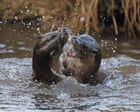
Wild Otter Battle Echoes Across the Isle of Lismore in Argyll
Observer Cal Flyn reported hearing unusual, high-pitched vocalizations on the Isle of Lismore in Argyll. Upon investigating, the sounds were traced to otters skimming the water's surface and engaging in a loud, riotous battle.
New DNA Evidence Reveals Extinct 'American Cheetah' Was Not Actually a Cheetah
Recent DNA analysis of ancient bones found in the Yukon reveals that the extinct North American cat known as the 'American Cheetah' was not actually a cheetah. Furthermore, researchers found that some of these creatures maintained a diet closer to that of orcas than other big cats.

Protected Turtles Flee Poisoned Waters in Kajalheri Sanctuary
Turtles residing in the Kajalheri sanctuary have been forced to escape from contaminated waters. The affected species hold the highest statutory protection under Indian law. Environmental concerns are mounting over the safety of the sanctuary's aquatic ecosystem.
Suspicious Signal Detected in South Dakota Laboratory Sparks Dark Matter Speculation
Physicists are expressing excitement following the detection of a suspicious signal in a dark-matter detector located at a South Dakota laboratory. Major scientific publications are questioning whether researchers may have finally caught a glimpse of a dark matter particle. The intriguing findings have drawn significant attention across the scientific community.