UK Mathematician Challenges Long-Standing Myth Regarding Parthenon's Architectural Curves
Quick Brief
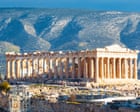
A new study by a UK mathematician challenges the centuries-old belief that the architectural curves of the Parthenon were built to correct optical illusions. For over two millennia, scholars have praised the clever geometry of the ancient Greek temple overlooking Athens.
What Happened?
A mathematician from the UK conducted a study examining optical illusions and the Parthenon, ultimately challenging the widely accepted notion that the temple's subtle curves were engineered to fix visual distortions that would have compromised its clean lines.
Why It Matters
The findings challenge a narrative that has persisted for over 2,000 years regarding the architectural brilliance and intentional geometric design of one of history's most famous structures.
Key Facts
- A UK mathematician conducted the study on the Parthenon.
- The research challenges a belief held for more than 2,000 years.
- The long-standing theory claimed the temple's curves corrected optical illusions.
- The Parthenon is an ancient Greek temple overlooking Athens on the Acropolis hill.
Compiled from 2 outlets
Related Stories
New High-Intensity Muonium Beam Developed for Gravity and Laser Spectroscopy
Scientists have successfully generated a novel, high-intensity, superthermal muonium beam. This development opens up new possibilities for conducting advanced laser spectroscopy and gravity experiments. Researchers suggest this technology could potentially challenge established gravitational theories, including Einstein's framework.

Monkeys and Wild Boars Lead Human-Wildlife Conflict in Wayanad
A multi-year scientific investigation across 49 villages in Wayanad has identified monkeys and wild boars as the primary drivers of human-wildlife friction. Researchers from Kannur University and the University of Geneva conducted the three-year study, noting that monkeys account for the largest share of reported interactions.
NASA Ames Honors September 2026 Stars of the Month
The NASA Ames Science Directorate has announced its Stars of the Month for September 2026. Seven staff members were recognized for embodying the entrepreneurial and collaborative spirit required for space exploration. The honorees include specialists spanning various scientific and technical roles.
NASA's Roman Space Telescope Exceeds Expectations with 22-Year Gas Supply
NASA's Nancy Grace Roman Space Telescope has secured enough gas to support 22 years of scientific operations, doubling its original projected lifespan. The milestone follows a precise engine burn executed after the activation of the observatory's primary instrument and coronagraph checks.